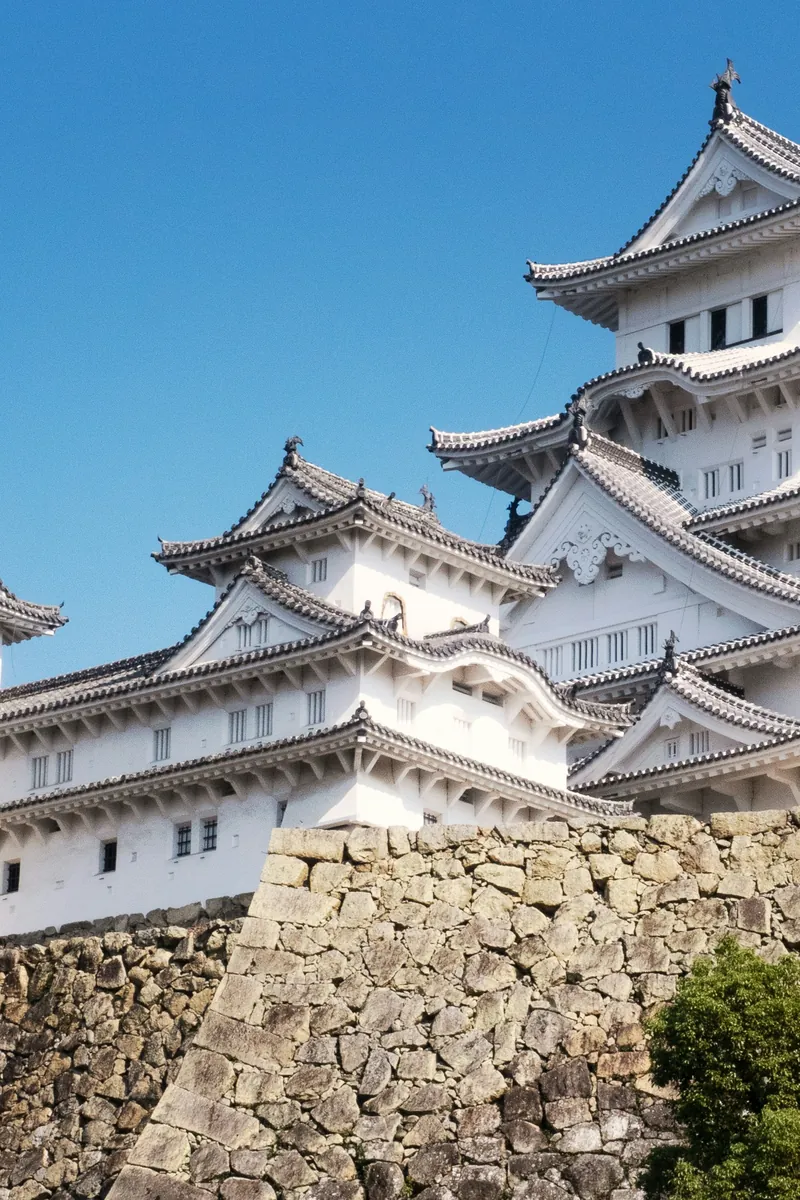
Himeji Castle is the supreme surviving example of a Japanese castle — and, almost uniquely, an original one. Where most of Japan's famous castles are 20th-century concrete reconstructions, Himeji's six-storey wooden keep is the real thing, completed in 1609 under Ikeda Terumasa and standing essentially unchanged for over four hundred years. It is the largest and most visited castle in Japan, and in 1993 it became one of the country's very first UNESCO World Heritage Sites.
Its brilliant white-plastered walls and the way its roofs seem to spread like wings gave it the name Shirasagi-jo — 'White Heron Castle'. The whiteness is not just beauty: the thick fire-resistant plaster that coats the timber and tiles helped the castle survive where others burned. Remarkably, Himeji came through the air raids that flattened the surrounding city in 1945, and through the Great Hanshin earthquake of 1995, with the keep intact — a building that has never been destroyed in its entire history.
Inside, you climb the keep itself, floor by floor in your socks, up wooden stairs that grow deliberately steeper to slow any attacker. Around it spreads a brilliant defensive puzzle of spiralling baileys, gates and walls designed to confuse and trap invaders. We are an independent concierge service for international visitors: we book your timed entry in English, charge in your own currency, and send a QR e-ticket and a short audio history before you arrive — so the language barrier never stands between you and the castle.